

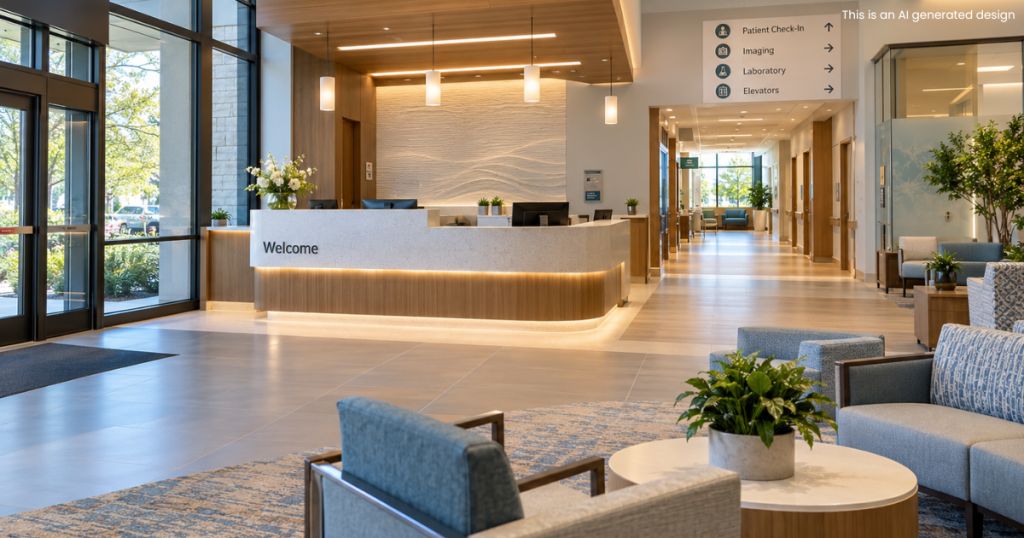
Before a patient meets their care team, they have already experienced the design.
They have entered the building, searched for their destination, approached reception, found a place to wait, and absorbed dozens of details—often without consciously noticing them.
Is the entrance easy to navigate? Does the environment feel clean and organized? Is there privacy at check-in? Does the waiting area feel comfortable? Can patients intuitively understand where they need to go next?
These are not simply aesthetic considerations. They are part of the patient experience.
Thoughtful healthcare interior design can begin establishing confidence before a clinical conversation ever takes place. Through intentional space planning, lighting, materials, acoustics, wayfinding, furniture selection, and other design decisions, healthcare environments can communicate something essential:
You have been considered here.
The Patient Experience Begins at the Entrance
Patients rarely enter healthcare environments without some degree of uncertainty.
Even a routine appointment may come with questions. A diagnostic test, procedure, or specialist visit can carry considerably more anxiety.
The physical environment can either add to that uncertainty or help reduce it.
This makes the arrival experience an important component of patient-centered healthcare design.
Clear sightlines can make reception easier to locate. Intuitive circulation can reduce confusion. Thoughtful wayfinding can help patients understand where to go without repeatedly stopping to ask for directions.
Even the placement and orientation of a reception desk can influence how welcoming and understandable a space feels.
Great healthcare design begins by asking not only, “How should this space look?” but also, “How will someone experience this space for the first time?”
That shift in perspective can change the entire design process.
Good Design Makes Care Visible
Patients cannot evaluate the technical quality of their healthcare simply by looking around a room.
They can, however, observe their surroundings.
A well-maintained interior, cohesive material palette, uncluttered reception area, comfortable furniture, and thoughtfully planned environment can communicate organization and attention to detail.
This matters because the physical environment becomes one of the earliest tangible expressions of a healthcare organization’s identity.
The architecture and interiors are quietly communicating before anyone introduces themselves.
A space designed with care can help make an organization’s commitment to care visible.
Privacy Is Designed, Not Assumed
Few environments require people to share information as personal as the information exchanged in healthcare settings.
Yet privacy can sometimes be compromised by something as simple as the distance between a reception desk and a waiting chair.
Effective hospital and healthcare interior design considers both visual and acoustic privacy throughout the patient journey.
That can influence decisions about:
Reception and check-in configurations
Seating arrangements
Acoustic materials
Room separation
Circulation patterns
Consultation spaces
Check-in and check-out areas
These decisions may appear functional, but their emotional impact can be significant.
When patients can speak without feeling overheard or wait without feeling exposed, the environment communicates respect.
And respect is fundamental to trust.
Designing Calm Without Sacrificing Function
Healthcare environments must perform exceptionally well.
They need to support infection-control requirements, accessibility, staff workflow, durability, maintenance, technology, safety, and countless operational demands.
But function and comfort do not have to compete.
The most successful healthcare interiors integrate them.
Natural light, views to the outdoors, biophilic elements, carefully selected colors and materials, comfortable furniture, and controlled acoustics can soften the clinical experience while maintaining the performance healthcare environments require.
The goal is not to disguise a healthcare facility as something it isn’t.
Instead, the opportunity is to create an environment that feels professional without feeling intimidating, clinical without feeling cold, and efficient without feeling impersonal.
That balance is where thoughtful design becomes particularly powerful.
Wayfinding Is More Than Signage
Imagine arriving at a medical facility already worried about an appointment—and then realizing you have no idea where to go.
Even small moments of confusion can increase frustration.
Good wayfinding begins long before signs are installed.
Architecture, interior design, lighting, flooring transitions, color, landmarks, visibility, and circulation can all help people intuitively understand a building.
A corridor that naturally leads toward reception. A visual landmark that distinguishes one department from another. A change in material that subtly signals a transition.
These elements work together to create environments that are easier to navigate.
When patients can confidently move through a healthcare facility, design has removed one unnecessary source of stress from their experience.
One Waiting Room Does Not Fit Everyone
The traditional waiting room is often designed around a simple idea: provide enough chairs.
Patient-centered design asks a different question:
How will different people actually use this space?
A parent may need to sit beside a child. An older adult may benefit from seating with supportive arms. A patient using a wheelchair needs appropriate circulation and seating integration. Some visitors may want privacy, while families may need to remain together.
Thoughtful furniture selection and space planning can accommodate these different experiences without making the environment feel fragmented.
The result is more than a visually appealing waiting room.
It is an environment that acknowledges the people using it.
Healthcare Design Must Also Support the People Providing Care
Patient trust is influenced not only by what patients see but also by how smoothly care is delivered around them.
That makes staff experience an important part of healthcare design.
Efficient adjacencies, appropriate storage, ergonomic work areas, well-planned clinical spaces, effective lighting, and clear circulation can support the physicians, nurses, technicians, and administrative teams who use these environments every day.
When staff can move efficiently through a space and access what they need, the benefits can extend throughout the patient experience.
In this way, designing for staff and designing for patients are not separate goals.
They are interconnected parts of a healthcare environment that works.
The Most Powerful Design Decisions May Be the Ones Patients Never Notice
Patients may never comment on the acoustical strategy.
They probably will not know why the reception desk was placed at a particular angle.
They may not consciously recognize how lighting, furniture placement, circulation, and material transitions are helping them navigate the space.
But they experience the results.
They know when they can easily find reception.
They notice when a chair is comfortable.
They feel when a conversation is private.
They recognize when an environment seems organized and cared for.
Great design does not always demand attention.
Sometimes its greatest success is making a difficult experience feel a little easier.
Designing Trust Into the Entire Healthcare Journey
Healthcare interior design extends far beyond creating an attractive lobby or selecting finishes.
It is about understanding how architecture, interiors, operations, staff needs, and human emotion intersect.
Every part of the patient journey presents an opportunity: arrival, check-in, waiting, consultation, treatment, recovery, and departure.
When those experiences are considered as one connected journey, the healthcare environment can become more intuitive, supportive, and human.
And that is where design can begin building trust.
Not after the patient meets the physician.
Not after treatment begins.
But from the moment someone walks through the door.
Because before a word is spoken, the space has already introduced the organization behind it.
And great healthcare design makes that introduction count!