

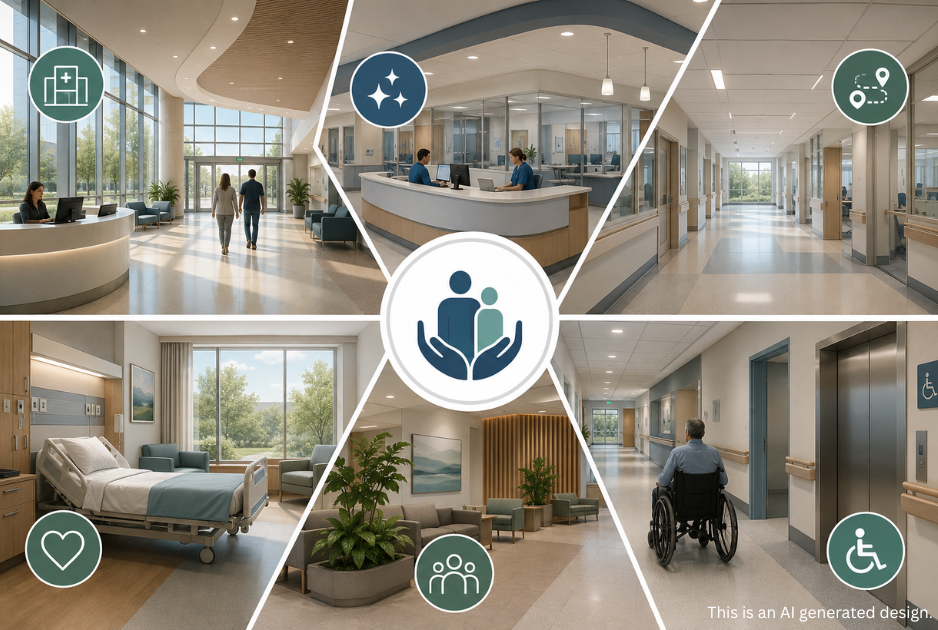
At Brandt Design Group, we approach healthcare design with a clear understanding: trust is not only built through clinical expertise—it is built through environment. Long before a patient meets a provider, the space itself is already communicating. Every material, sightline, and spatial decision shapes how patients feel about the care they are about to receive.
Healthcare environments are often emotionally charged. Patients arrive with uncertainty, families with concern, and staff with responsibility. In these moments, design plays a critical role in establishing calm, clarity, and confidence.
First Impressions Shape Confidence
The first few seconds inside a healthcare facility are powerful. Patients immediately register whether a space feels organized, calm, and intentional.
At Brandt Design Group, we design entry experiences that reduce uncertainty and create a sense of welcome from the outset. Natural light, clear spatial organization, and intuitive transitions from exterior to interior help set a reassuring tone. When a space feels thoughtfully composed, it signals that care within it is equally intentional.
Cleanliness Is Reinforced Through Design Clarity
While cleanliness is a clinical standard, it is also reinforced through design.
Material selection, detailing, and spatial composition all influence how clean and well-maintained a space feels. Simplified finishes, cohesive palettes, and uncluttered environments reduce visual noise and create a sense of order.
This clarity is not just aesthetic—it directly impacts patient perception. A visually organized environment supports the feeling that the healthcare system itself is structured, safe, and dependable.
Transparency Supports Wayfinding and Trust
Transparency in healthcare design is essential for reducing anxiety and building confidence.
We prioritize clear sightlines, legible layouts, and intuitive circulation patterns so patients can easily understand where they are and where they need to go. Glass elements, open views into key zones, and strategically framed destinations help reduce confusion.
When patients can visually comprehend a space, they feel more in control of their experience. That sense of control translates directly into trust.
Accessibility Reflects Care and Respect
At Brandt Design Group, accessibility is not treated as a requirement—it is treated as a design principle that reflects respect for every individual who enters a healthcare environment.
Thoughtful planning ensures that circulation paths, seating arrangements, entry points, and signage systems support users of all abilities. Inclusive design allows every patient to move through a facility with dignity and ease.
When spaces are designed to accommodate everyone, patients recognize that they are valued as individuals—not just as occupants of a system.
Comfort Through Environmental Experience
Trust is also influenced by how a space feels emotionally.
Lighting, acoustics, proportion, and material warmth all contribute to a sense of comfort. Soft transitions between public and private areas, carefully scaled waiting spaces, and calming environmental cues help reduce stress.
We design these environments to ease tension and support emotional well-being, ensuring that patients feel supported even before they receive care.
Design as a Reflection of Care Quality
Patients may not analyze architectural decisions, but they respond to them instinctively. A well-designed healthcare environment communicates competence, organization, and compassion without a single word being spoken.
At Brandt Design Group, we see design as an extension of care delivery. It shapes perception, influences emotion, and reinforces confidence in the healthcare experience.
Trust is not created in isolation—it is built through consistency across every touchpoint, starting with the environment itself.
When healthcare spaces are designed with intention, they do more than function well. They reassure, they guide, and most importantly, they build trust at every step of the patient journey.